
Growing Young Minds: The Benefits of Living Walls in Early Childhood Education

Learning doesn’t happen only at a desk. For young children, the environment around them can inspire curiosity, encourage observation, and create opportunities to connect with the natural world. By bringing living plants into an educational setting, a living wall can become more than a beautiful design feature, it can become part of the learning environment.
At Oak View Elementary’s Debbie Sykora Early Childhood Center in Bolingbrook, Illinois, LiveWall® brings that idea to life in the building’s entrance lobby. Positioned where it greets students, staff, faculty, and visitors, the living wall creates an inviting focal point and an immediate connection to nature.
A Living Welcome to the Learning Environment
The 6′-4″ wide by 6′-11″ tall LiveWall® features 20 WallTer® planters planted with Scindapsus ‘Silver Satin’ and Philodendron hederaceum ‘Brazil’. A rear-fed automatic irrigation system provides scheduled watering, helping maintain the plants while simplifying ongoing care.
One year after installation, the plants have grown into a lush, full display. Framed by the building’s interior finishes and positioned beside a prominent “WELCOME” display, the LiveWall® has become an integral part of the entrance.
Its location was intentional. DLA Architects Ltd., a firm specializing in educational design, specified LiveWall®, and the project’s general contractor, F.H. Paschen S.N. Nielsen & Associates, installed it.
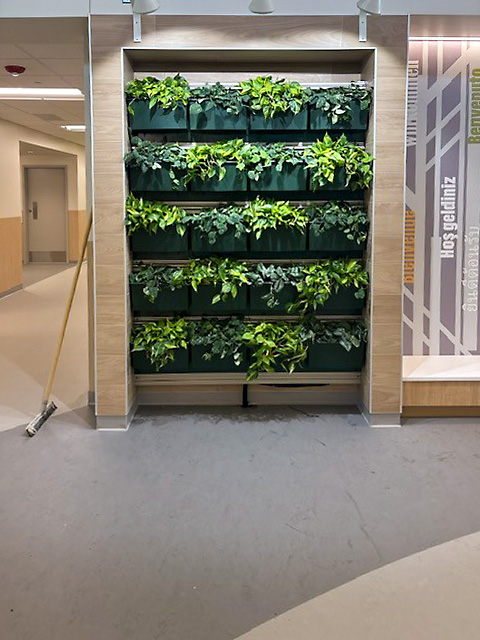
LiveWall® at Debbie Sykora Early Childhood Center, 2025, newly planted.
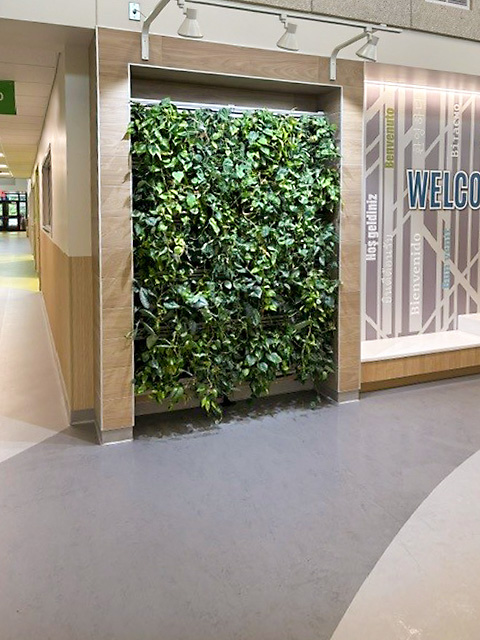
LiveWall® at Debbie Sykora Early Childhood Center, 2026, a year after installation.
Bringing Nature into the Learning Experience
Children are naturally curious about the world around them. A living wall provides an opportunity to encourage that curiosity through simple, everyday observations. Different leaf shapes, textures, colors, and patterns can prompt children to look more closely, ask questions, and notice how plants change over time.
That makes a living wall an educational tool as well as a design element. Students who participate in planting and maintaining living walls can develop an understanding of environmental stewardship, plant biology, air quality, and food systems.
Even when children aren’t directly involved in maintaining the wall, having living plants in their surroundings can create opportunities to talk about nature, growth, and caring for the environment.
Supporting Focus and Well-Being
The benefits of nature in educational environments extend beyond hands-on learning. Student exposure to nature has been correlated with higher academic performance in Math and English. Studies have also demonstrated that exposure to nature eases symptoms of ADHD. Living walls can help reduce mental fatigue, eye strain, and distractions, making it easier for students and educators to stay focused throughout the day. [1]
For an early childhood center, creating a welcoming and comfortable environment is especially important. A wall filled with living plants introduces natural elements into a space where children arrive, gather, transition between activities, and interact with adults and one another.
The result is an environment that feels more connected to nature while providing a visual element that can engage children throughout their day.
More Than a Beautiful Entrance
A living wall can also communicate something about the institution that chooses to include one. The LiveWall® installed here demonstrates the school’s commitment to health, sustainability, the environment, and community.
At Debbie Sykora Early Childhood Center, that message begins at the front door. The LiveWall® installation provides a warm and memorable welcome while introducing students and visitors to the idea that nature has an important place within the built environment. Its mature planting also demonstrates how a living wall can become an integral part of an architectural design. Rather than simply decorating the lobby, the greenery works alongside the wood-look tile surround, lighting, flooring, and adjacent “WELCOME” graphic display to create a distinctive entrance.

A Living Investment in Young Learners
Living walls can serve both an aesthetic and educational purpose in a wide variety of learning environments. They bring nature into the built environment, create inviting and engaging spaces, and provide opportunities for students to connect with the natural world. From encouraging curiosity and discovery to supporting well-being, a LiveWall® can become a meaningful part of the educational experience.
For young learners, that connection can become a source of questions, discovery, and wonder. Sometimes, the best learning opportunities are the ones growing right in front of us.
Interested in a Living Wall for an Educational Environment?
Would you like to receive a budgetary estimate for your project?
Would Your Team be Interested in a Virtual Educational Session about LiveWall®?
Send us a message and add “Educational Session” to the Subject line.